
The Best Hallway Carpets Are Not Always the Ones That Match the Living Room

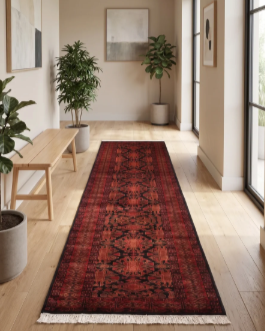
A hallway carpet is often chosen after the living room rug, with the expectation that the two should share a colour, pattern or material. It sounds like a sensible design decision. But a hallway has a different job from the room it connects.
In an Indian home, that stretch of flooring might connect the entrance to the bedrooms, pass a shoe cabinet, lead towards the kitchen or run alongside the drawing room. It is crossed repeatedly, sometimes with footwear, sometimes barefoot, and often while carrying groceries, laundry or serving trays.
A carpet that looks coordinated beside the living room may be entirely unsuitable for this stretch. The better choice begins with understanding how the passage functions.
A Hallway Is a Route, Not Another Living Room
Consider a city apartment where the entrance opens towards a narrow passage leading to the bedrooms. The living room may have a plush rug in a muted neutral shade, but extending the same design into the passage can create practical complications.
Bedroom doors need to swing freely. Cupboard doors may open into the passage. Shoe storage can reduce the available walking width. A thick carpet placed along this route may catch against doors or become an obstruction.
A Jaipur home with a longer passage presents a different design opportunity. If the corridor connects several rooms, a runner can create a visual line through the house. But its length should follow the usable passage, not simply imitate the proportions of the living-room abstract rug.
The distinction is important: a living room rug is usually arranged around furniture; a hallway carpet has to accommodate movement.
Why Matching the Living Room Can Be a Design Mistake
Matching two rugs exactly can make adjoining spaces feel coordinated, but it can also make them visually monotonous. A better approach is to establish a relationship between the two rather than repeat the same design.
For example:
- A living room with a large Persian rug could connect to a hallway runner with a restrained border pattern.
- A neutral living room could accommodate a more pronounced geometric runner.
- A room with heavily patterned upholstery may benefit from a quieter hallway design.
- A living room with deep blue or green accents could carry one of those colors into the passage without repeating the entire palette.
The eye should recognise a connection between the spaces, not mistake them for one continuous decorative arrangement.
The Entrance-to-Bedroom Route Needs a Different Carpet
Not every passage experiences the same kind of use. The stretch immediately inside the main entrance is exposed to a different set of conditions from the corridor connecting bedrooms. An entrance passage may sit close to shoe storage, the main door, and the area where outdoor dust first enters. A bedroom corridor may be used more frequently barefoot. A passage leading towards a kitchen may experience occasional spills or more frequent movement.
These differences should influence the choice of carpet.
A practical distinction:
| Passage | What deserves attention |
| Near the main entrance | Ease of cleaning, secure placement and manageable pile |
| Bedroom corridor | Door clearance, comfortable underfoot feel and stable edges |
| Kitchen-facing passage | Spill exposure and ease of maintenance |
| Long connecting corridor | Proportion, visual continuity and unobstructed movement |
A single design specification does not suit every passage simply because each is called a hallway.
The Most Important Detail May Be the Carpet’s Thickness
This is where appearance needs to take a back seat.
The Government of India’s Harmonised Guidelines for a Barrier-Free Environment advise avoiding carpeting on accessible circulation routes. Where carpet is used, it should be securely fixed and have a pile depth no greater than 12 mm. The guidance is intended for accessible environments, not as a universal specification for every private home, but its safety principle is relevant to residential passageways too.
Before choosing a hallway carpet, check:
- Whether the main door and bedroom doors clear its surface.
- Whether the handmade carpet moves when someone walks across it.
- Whether its edges curl or lift.
- Whether it narrows an already restricted passage.
- Whether the surface creates difficulty for elderly residents or anyone using a walking aid.
A non-slip underlay or suitable securing method can help, but it must be compatible with the floor finish. On polished marble or vitrified tiles, an unsecured runner deserves particular attention.
Should a Hallway Have a Runner or a Wider Carpet?
The shape of the passage should settle this decision. A carpet runner suits a long, narrow route where the central walking line needs definition. A wider hallway carpet can work in a foyer or broad passage with enough exposed flooring around it.
There is little benefit in forcing a runner into a short entrance area where a smaller rug would make more sense. Equally, placing a small accent rug halfway down a long corridor can make the arrangement look accidental.
Measure the usable width after accounting for open doors and furniture. Then assess the length from one natural transition point to another. A runner should define the route without becoming an obstacle.
Let the Hallway Belong to the House, Not Copy the Living Room
The most successful hallway carpets do not necessarily repeat the living-room design. They respond to the architecture, floor finish, movement and visual character of the adjoining rooms.
A carefully chosen runner can introduce a different pattern, carry one colour through the house or give a long passage a clearer visual direction. Sometimes, however, leaving a narrow or heavily used corridor uncovered is the better decision.
The purpose of a hallway carpet is not to complete a matching set. It is to make the transition between rooms feel considered while keeping the route safe and usable.